From product strategy to technical delivery

Present with Reveal.js or open the text versions. Download PowerPoint · Download PDF · Download Reveal.js

Slide 1: APIOps Cycles

Slide 1: APIOps Cycles
Read text version of slide 1

APIOps Cycles

Product strategy, architecture and delivery with AI

An introduction grounded in a financial-services case

Case study: APIsFirst with partner Osaango

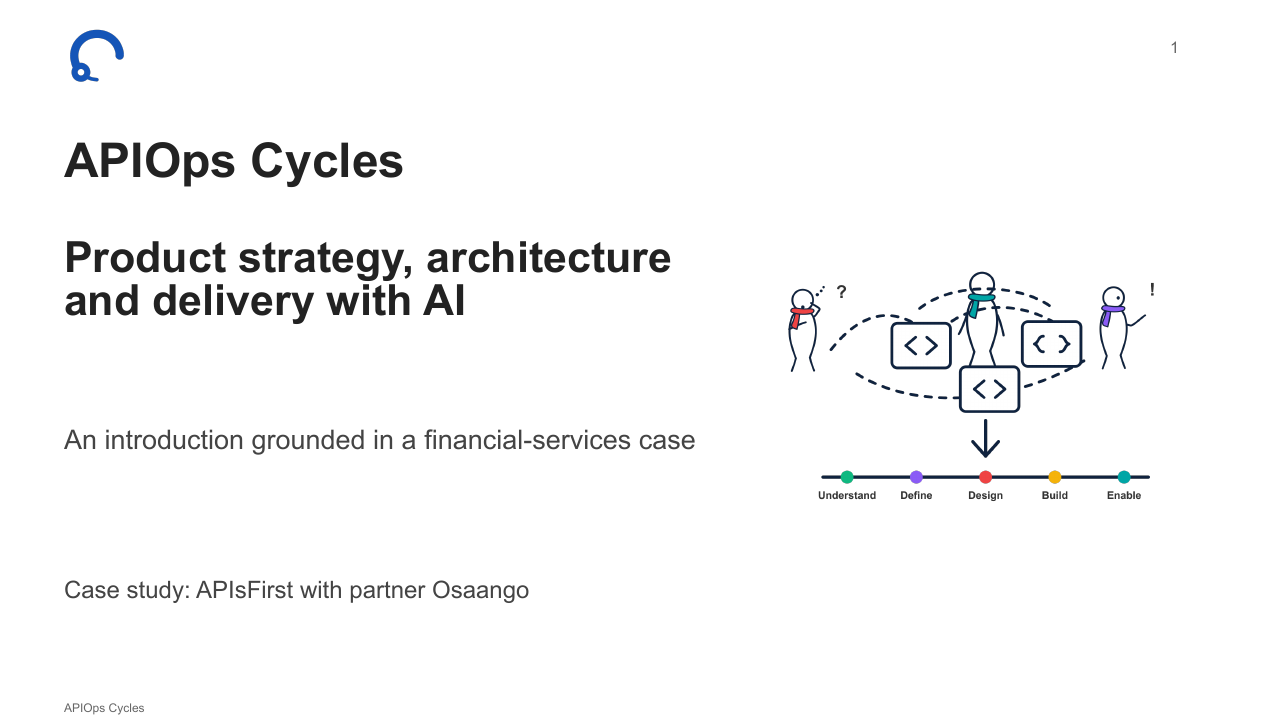
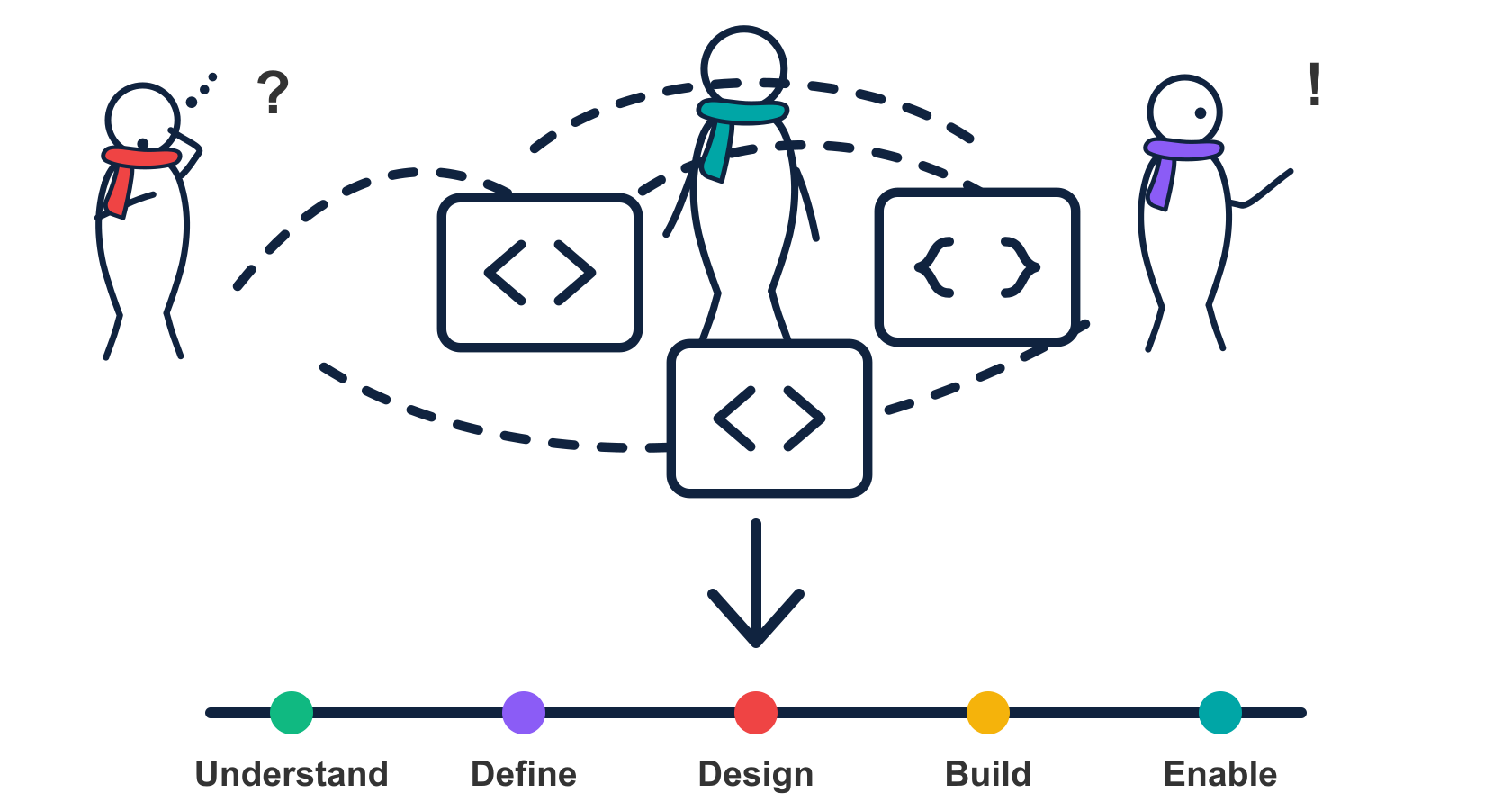
Visual: APIOps human scene showing connected discovery and delivery roles

Slide 2: APIOps Cycles connects decisions across the lifecycle

Slide 2: APIOps Cycles connects decisions across the lifecycle
Read text version of slide 2

An open method for connecting consumer value with architecture, design, delivery and continuous improvement.

Cycle viewPrimary focus
Capability ProductizationDefine a reusable capability and the service promise.
API ProductizationDevelop, publish and improve an API as a product.
Integration ProductizationConnect providers and consumers through reusable integrations.
AutomationDesign and govern workflows, agents and operational controls.

This introduction follows API Productization, with a financial-services case and an illustrative payment continuation.

Slide 3: API Productization Cycle metro map

Slide 3: API Productization Cycle metro map
Read text version of slide 3

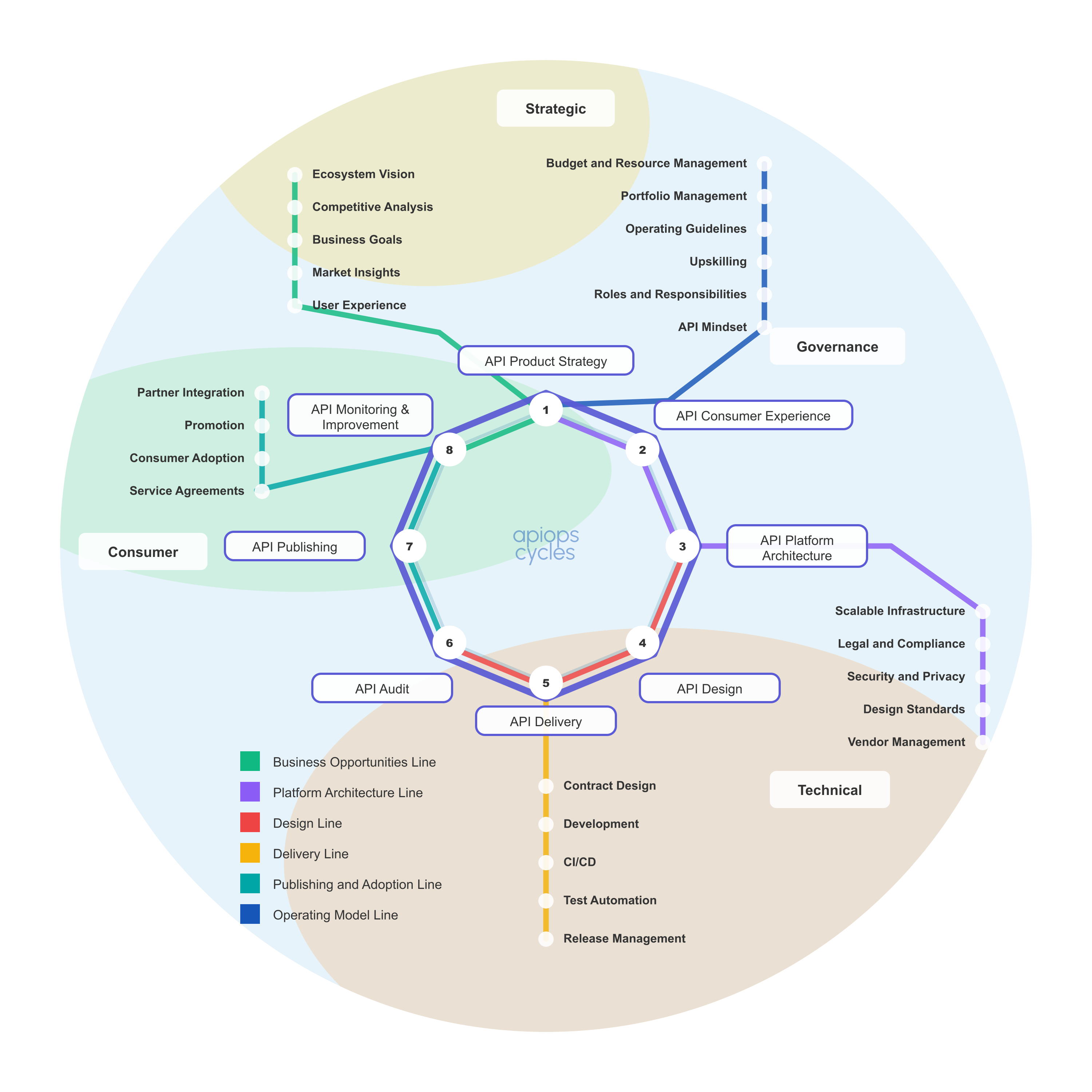
Visual: Official API Productization Cycle metro map exported from the repository application

One lifecycle connects the work

  1. API Product Strategy
  2. API Consumer Experience
  3. API Platform Architecture
  4. API Design
  5. API Delivery
  6. API Audit
  7. API Publishing
  8. API Monitoring & Improvement

The engagement connected discovery to design, delivery and testing across these stations.

Slide 4: The challenge: dependencies across teams

Slide 4: The challenge: dependencies across teams
Read text version of slide 4

Established API engineering practices

API products still depended on business and technology teams working across organisational boundaries.

Customer journeys and partner integrations had to fit internal services, legacy systems and compliance obligations.

Visual: APIOps human scene showing uncertainty around shared APIs and contracts

Teams needed shared requirements, clearer ownership and coordinated delivery decisions.

Slide 5: Collaborative discovery in the payments case

Slide 5: Collaborative discovery in the payments case
Read text version of slide 5

What the team did

APIsFirst and Osaango facilitated iterative workshops with business stakeholders, architects and engineers.

What the canvases made visible

Customer and API consumer journeys, value propositions, business rules and operating constraints.

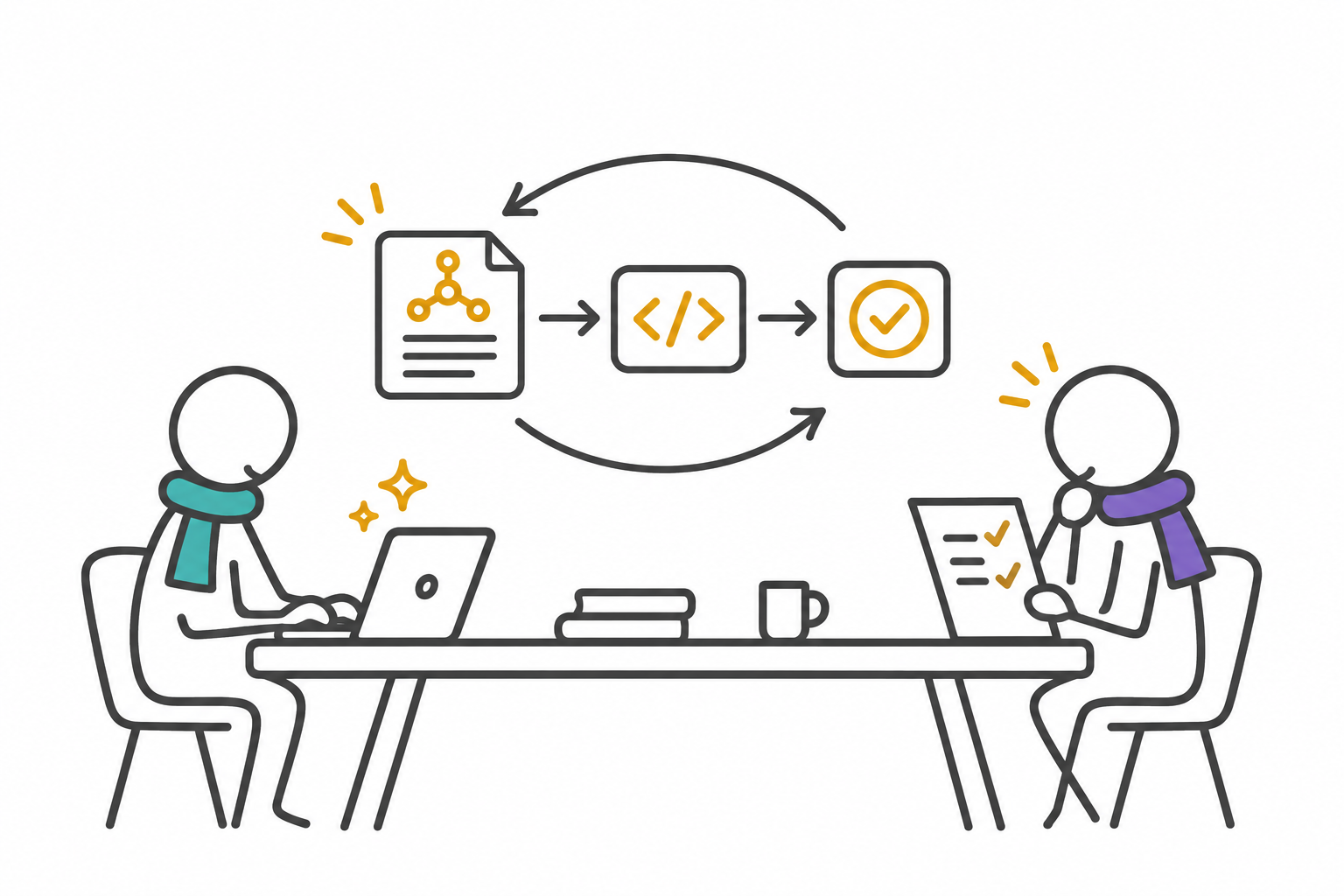
Visual: Generated conceptual APIOps workshop scene, not a photograph or project artefact

Payments example: consumer details, payment method access, business risks and internal or partner channel needs.

Slide 6: Customer Journey Canvas: a supplier payment

Slide 6: Customer Journey Canvas: a supplier payment
Read text version of slide 6

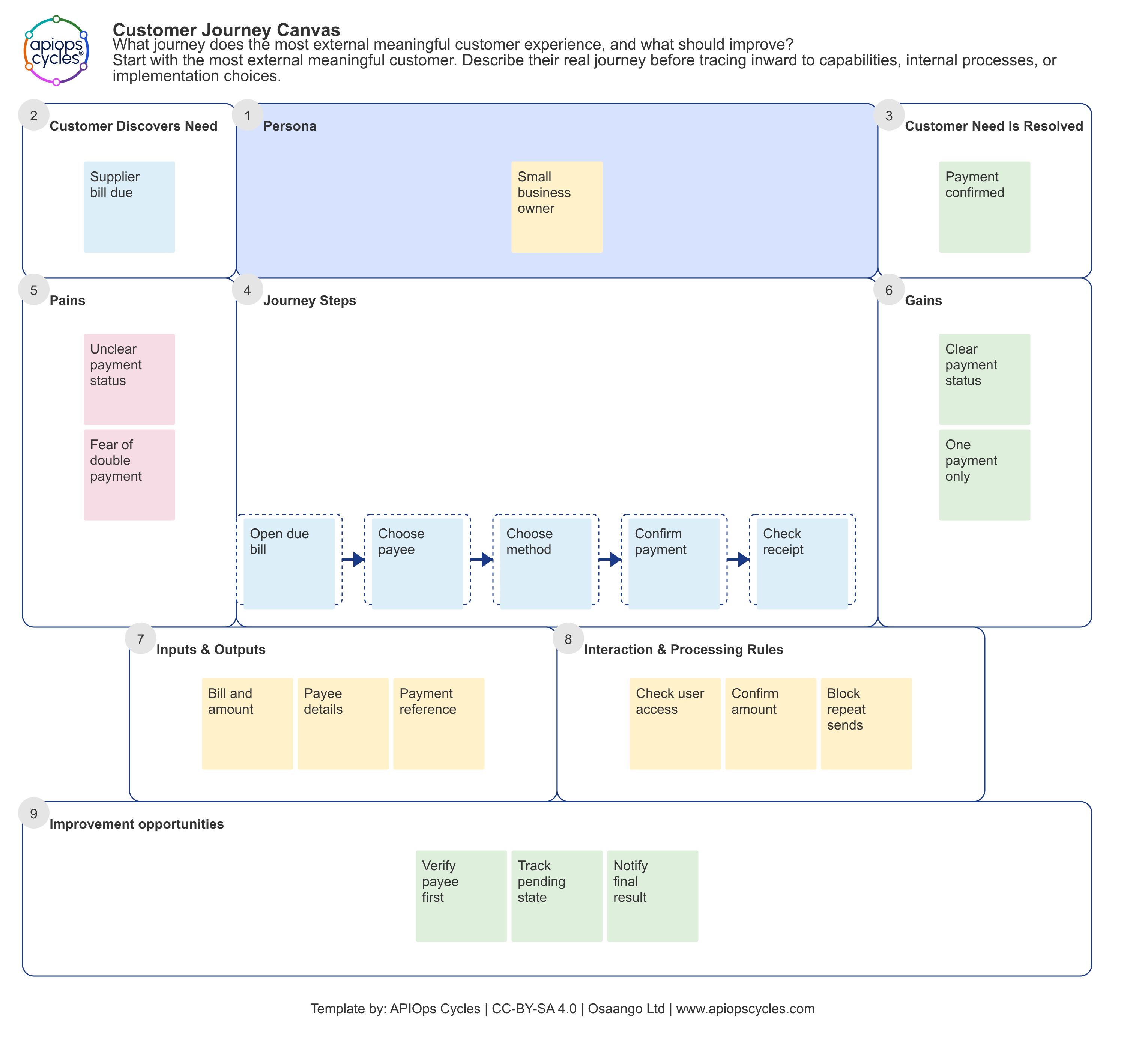
Visual: New illustrative filled Customer Journey Canvas for a small business owner paying a supplier invoice

Customer and trigger

A small business owner has a supplier bill due and wants to know the payment has completed.

The customer journey

  1. Open the due bill
  2. Choose the payee
  3. Choose a payment method
  4. Confirm the payment
  5. Check the receipt

Illustrative example. Not a client artefact.

Slide 7: API Value Proposition Canvas: the same journey

Slide 7: API Value Proposition Canvas: the same journey
Read text version of slide 7

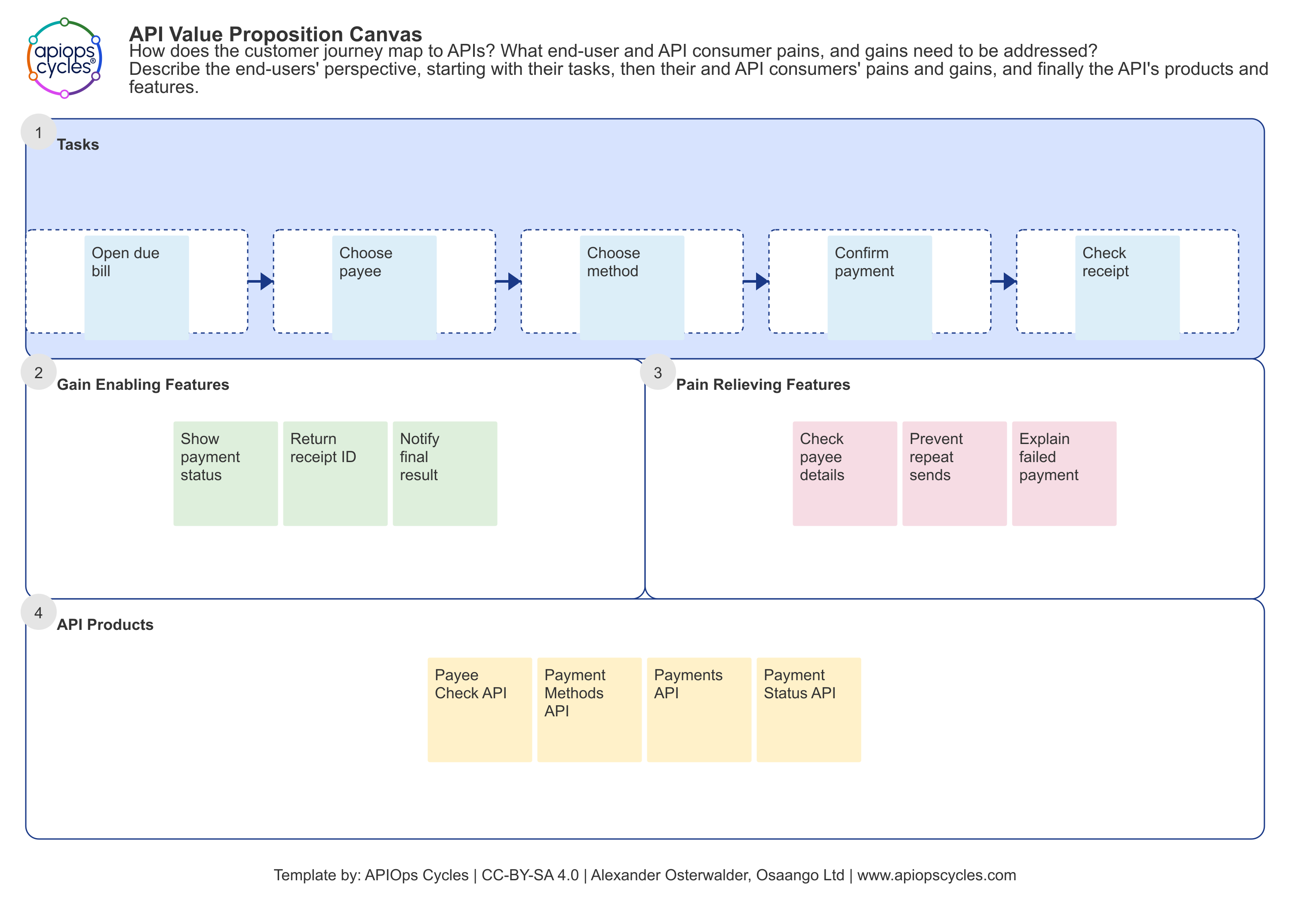
Visual: New illustrative filled API Value Proposition Canvas using the same supplier-payment tasks

Customer concern to API feature

Unclear payment status: show progress and a receipt. Repeat-payment concern: prevent duplicate submissions.

Candidate API products

  • Payee Check API
  • Payment Methods API
  • Payments API
  • Payment Status API

Illustrative example. API names are provisional.

Slide 8: Other canvases supporting API product decisions

Slide 8: Other canvases supporting API product decisions
Read text version of slide 8

Visual: New illustrative supplier-payment API Business Model Canvas

API Business Model Canvas

Value, partners and costs of the payments service

Visual: New illustrative supplier-payment Business Impact Canvas

Business Impact Canvas

Expected benefits, consequences and critical risks

Visual: New illustrative supplier-payment Capacity Canvas

Capacity Canvas

Demand baseline, peak load and scaling decisions

Visual: New illustrative supplier-payment REST API Canvas

REST API Canvas

Payment resources, verbs and response examples

Illustrative supplier-payment examples. Capacity measurements and assumptions require validation.

Slide 9: Discovery informed decisions across the lifecycle

Slide 9: Discovery informed decisions across the lifecycle
Read text version of slide 9

Payment API design connected consumer needs to technical controls

Consumer tasksRequirementsAPI designControlsTesting
Journeys and channel needsBusiness rules and constraintsDomain model and contractsAccess, limits and monitoringAPI test automation

Practical support

Guidance on API contracts and test automation. Cross-team input on unresolved architecture and security decisions.

AI modernisation guidance

Advice on using AI to convert legacy interfaces while retaining business requirements and constraints.

Slide 10: API product management in everyday work

Slide 10: API product management in everyday work
Read text version of slide 10
  • Consumers and value: Who uses the API, and what does it help them do?
  • Ownership: Who is responsible for the product over its lifecycle?
  • Reuse and adoption: How can other teams discover and use the capability?
  • Lifecycle decisions: How should the product evolve as needs change?
  • Governance and developer experience: How do practices support product outcomes?

Visual: APIOps human scene connecting an API interface to a reusable product capability

Slide 11: Portfolio planning coordinated API releases

Slide 11: Portfolio planning coordinated API releases
Read text version of slide 11

Which APIs to create, improve or release, and in what sequence

Visual: Generated conceptual API dependency and release-coordination scene

API portfolio planning

Priorities reflected partner integrations, UI development and dependencies between provider and consumer teams.

Capability improvement

A complementary view addressed API discoverability, governance, developer experience and product management.

Slide 12: The value across products, portfolio and ways of working

Slide 12: The value across products, portfolio and ways of working
Read text version of slide 12

Connected work made decisions easier to discuss and repeat

LevelWhat the engagement connectedQualitative value
API productConsumer needs, business rules, contracts and technical controlsShared understanding and more informed design
API portfolioProvider and consumer dependencies with API priorities and releasesEnd-to-end visibility and coordinated delivery
Ways of workingProduct ownership and lifecycle decisions with practical methodsRepeatable capability and continuous improvement

Qualitative benefits of the engagement. No quantified delivery or business impact is claimed.

Slide 13: Architecture: business needs become operating decisions

Slide 13: Architecture: business needs become operating decisions
Read text version of slide 13
Method inputDecision it supportsReview with
Business Impact CanvasFailure consequences, resilience and acceptable degradationProduct owner, security and operations
Locations CanvasTrust boundaries, connectivity and data-location constraintsArchitecture, security and compliance
Capacity CanvasDemand, peaks, availability and scaling assumptionsBusiness and platform owners
Metrics and analyticsObservable service behaviour and consumer outcomesOperations and API product owner

The next station needs architecture choices that stakeholders have reviewed.

Slide 14: A payment requirement can change the architecture

Slide 14: A payment requirement can change the architecture
Read text version of slide 14
Customer or business needProposed design decisionEvidence to review
One payment per instructionDefine replay handling and a durable deduplication recordRepeated request and concurrent-submission tests
Clear progress and final outcomeSeparate resource creation from completion of the business paymentState-transition and consumer walkthrough tests
A partner sees only its paymentsEnforce access for the requested object and the caller contextCross-partner denial tests
Dependable month-end serviceMeasure peak demand and agree capacity and recovery behaviourLoad tests and failure recovery evidence

Illustrative choices to validate, rather than facts about the client implementation.

Slide 15: Trust boundaries and capacity need explicit answers

Slide 15: Trust boundaries and capacity need explicit answers
Read text version of slide 15

Visual: New illustrative Locations Canvas for the partner payment example

Trust and access

  • Identify the caller and permitted payment objects.
  • Agree exposed endpoints, network paths and data locations.

Demand and resilience

  • Measure normal and peak demand before setting limits.
  • Test retries, delays and recovery without duplicate processing.

Slide 16: API design starts with shared domain meaning

Slide 16: API design starts with shared domain meaning
Read text version of slide 16

Visual: New illustrative Domain Canvas using the supplier-payment journey

Payment and payee

A payment is an instruction with an amount, currency, payee and a lifecycle status.

Business rules shape the contract

  • Keep accepted, pending and completed meanings distinct.
  • Agree ownership and the source of truth for state changes.

Slide 17: Interaction design precedes the interface contract

Slide 17: Interaction design precedes the interface contract
Read text version of slide 17
Consumer taskCandidate interactionContract questions
Submit a payment instructionREST request creating a payment resourceRequired data, replay behaviour, creation response and errors
Check the outcomeREST query returning the current payment stateStatus meaning, freshness and permitted access
Receive a final updateEvent or callback if consumer needs justify itDelivery, retry, ordering and duplicate handling
Compose a portal viewGraphQL only where its query model serves the needSchema, authorisation and query-cost controls

The Interaction Canvas explores the flow; REST, Event or GraphQL canvases refine the chosen style.

Slide 18: Contract-first design makes behaviour reviewable

Slide 18: Contract-first design makes behaviour reviewable
Read text version of slide 18
POST /payments
Idempotency-Key: <request-key>

201 Created
{
  "paymentId": "pay-42",
  "status": "pending"
}

Decisions around this operation

  • Define amount, currency, payee and validation errors.
  • Specify replay scope, retention and conflicting-payload behaviour.
  • Declare authentication and required permissions.
  • Keep resource creation distinct from payment completion.

Illustrative contract excerpt. The idempotency policy still needs agreement and implementation.

Slide 19: The scaffold gives people and AI a shared workspace

Slide 19: The scaffold gives people and AI a shared workspace
Read text version of slide 19
npm create apiops@latest payments
cd payments
npm run method:start
npm run method:canvases:new-api

Choose API Productization and REST in the prompts. The tooling requires Node.js 22 or later.

Project locationPurpose
specs/canvases/Editable method decisions
specs/openapi/api.yamlProject-owned API contract
docs/api/Review and generated outputs
spectral/ and scripts/Lint rules and audit checks
.github/workflows/Automated review workflow

The starter includes a sample Catalog contract; your team builds the payment runtime in its chosen language.

Slide 20: AI needs the decisions behind the contract

Slide 20: AI needs the decisions behind the contract
Read text version of slide 20
Input supplied to AIWhat it constrainsHuman owner
Journey and value propositionSupported task, intended value and consumer expectationsProduct and consumer representatives
Domain and architecture outputsMeaning, ownership, trust and operational constraintsDomain, architecture and security owners
Validated contract and style guideInterface behaviour, validation and shared conventionsAPI designer
Audit findings and test evidenceKnown gaps, acceptance criteria and the next bounded changeEngineering and readiness owners

AGENTS.md and package skills provide a route through the method; the team still validates the decisions.

Slide 21: Building with AI works best as a bounded change

Slide 21: Building with AI works best as a bounded change
Read text version of slide 21
  1. Select one reviewed operation and its acceptance criteria.
  2. Ask for an implementation diff and tests against the contract.
  3. Run checks, inspect behaviour and record unresolved decisions.
  4. Have the responsible people review the evidence before merging.

Visual: Generated conceptual APIOps scene of AI-assisted implementation and human review

Suggested task: implement payment submission with replay and cross-partner denial tests.

Slide 22: Tests turn the payment promises into evidence

Slide 22: Tests turn the payment promises into evidence
Read text version of slide 22
Promise or riskExample testWhat to inspect
Contract consistencyValidate valid and invalid requests and responsesSchemas, error bodies and documented status codes
Replay protectionRepeat a request and submit concurrent duplicatesStable result and no duplicate processing
Partner isolationRead or alter a payment owned by another partnerDenied access and appropriate audit evidence
Clear failure behaviourSimulate a slow or unavailable dependencyAgreed timeout, recovery and consumer-visible status
Peak demandExercise a measured peak traffic modelLatency, errors and resource consumption

These tests extend the scaffold with runtime evidence for the chosen implementation.

Slide 23: Linting checks the contract against explicit rules

Slide 23: Linting checks the contract against explicit rules
Read text version of slide 23
npm run lint:openapi:full-crud
Scaffold profileRules in the inspected templateUse in this example
read-onlyspectral:oas, a versioned server path and bans on write methodsFor a genuinely read-only API
full-crudThe shared base rules, without the read-only verb bansFor the payment API with POST

The full-crud name permits writes; it does not require every CRUD operation.

The scaffold validate:openapi command runs both profiles, so a write-enabled API needs a deliberate profile choice.

Slide 24: API Audit brings evidence together across the lifecycle

Slide 24: API Audit brings evidence together across the lifecycle
Read text version of slide 24
npm run audit:design:full-crud
Coverage areaEvidence to review
Strategy and architectureConsumer value, architecture decisions, trust boundaries and capacity
DesignContract checks, examples, conventions and consumer review
DeliveryFunctional, security, resilience and performance tests
PublishingDocumentation, access, support and readiness decisions
ImprovingRuntime metrics, adoption and feedback connected to the next change

The report uses pass, partial, gap and not applicable. Manual items require evidence and owner review.

Slide 25: A check result needs a clear interpretation

Slide 25: A check result needs a clear interpretation
Read text version of slide 25
Starter check or signalWhat the inspected code checksEvidence to add
Examples pass validationPresence of an example somewhere in the specificationActual example-to-schema validation
Validation workflow presentExistence of the expected workflow fileSuccessful execution and meaningful test results
Opaque identifier checkNames specific to the starter Catalog exampleChecks adapted to payment identifiers and contracts
Manual readiness itemThe checklist default status, commonly partialReview of the actual evidence by the accountable owner

Adapt the starter checks to the API domain before treating coverage as a release decision.

Slide 26: CI can keep the review evidence current

Slide 26: CI can keep the review evidence current
Read text version of slide 26

Included scaffold workflow

  1. Install dependencies with npm ci.
  2. Lint the selected profile and generate audit reports.
  3. Publish the JUnit coverage result as a GitHub check.

Extend for the payment implementation

  • Run contract, integration, security and load tests.
  • Define which lint findings, gaps and failed tests block release.
  • Review changes to contracts, controls and generated evidence together.

Audit outputs: JSON for tooling, Markdown and HTML for review, JUnit for CI.

Slide 27: Publishing and improvement complete the product cycle

Slide 27: Publishing and improvement complete the product cycle
Read text version of slide 27

API Publishing

  • Publish the reviewed contract and consumer-facing examples.
  • Make access, onboarding and support ownership clear.
  • Keep service terms and operational responsibilities visible.

API Monitoring & Improvement

  • Observe payment completion, pending age, latency and errors.
  • Combine runtime evidence with adoption and consumer feedback.
  • Revisit architecture, contracts and priorities when assumptions change.

The next improvement starts with evidence from consumers and operations.

Slide 28: A first working cycle

Slide 28: A first working cycle
Read text version of slide 28
  1. Agree one API product, a consumer journey and an accountable owner.
  2. Record the architecture choices and review one contract.
  3. Build one path with AI assistance and meaningful tests.
  4. Lint, audit and share findings before the next release decision.

Method and project resources

  • apiopscycles.com
  • apiops-cycles-method-data
  • create-apiops
  • CanvasCreator

Local reference versions checked: method-data 4.2.1 and create-apiops 1.1.4. 3 November 2026.

Use arrow keys or swipe to navigate, Esc for slide overview and S for speaker view. Back to presentation details and source.