APIOps Cycles overview
Present with Reveal.js or open the text versions. Download PowerPoint · Download PDF · Download Reveal.js

01
APIOps Cycles
Connecting API strategy,
design and delivery
A short introduction to APIOps Cycles
APIOps Cycles
APIOps Cycles
02
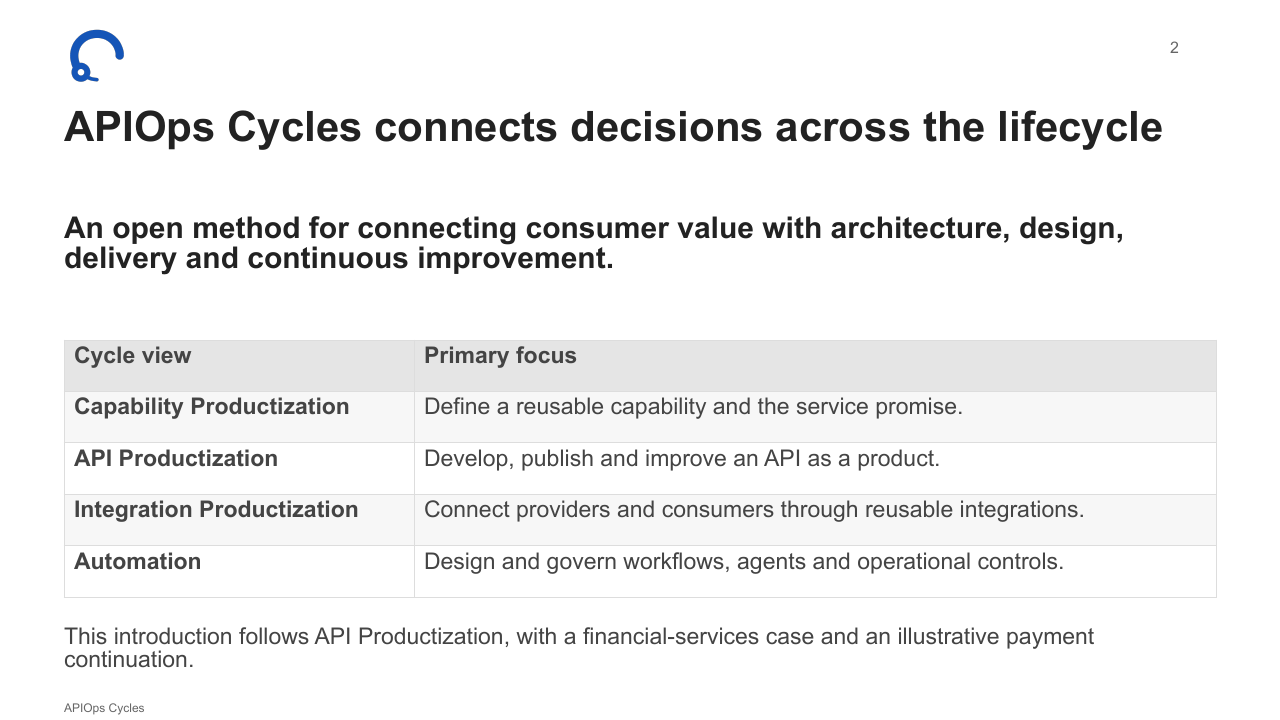
APIOps Cycles connects decisions across the lifecycle
An open method for connecting consumer value with architecture, design, delivery and continuous improvement.
| Cycle view | Primary focus |
|---|
| Capability Productization | Define a reusable capability and the service promise. |
| API Productization | Develop, publish and improve an API as a product. |
| Integration Productization | Connect providers and consumers through reusable integrations. |
| Automation | Design and govern workflows, agents and operational controls. |
This introduction follows API Productization, with a financial-services case and an illustrative payment continuation.
APIOps Cycles
03
API Productization Cycle metro map
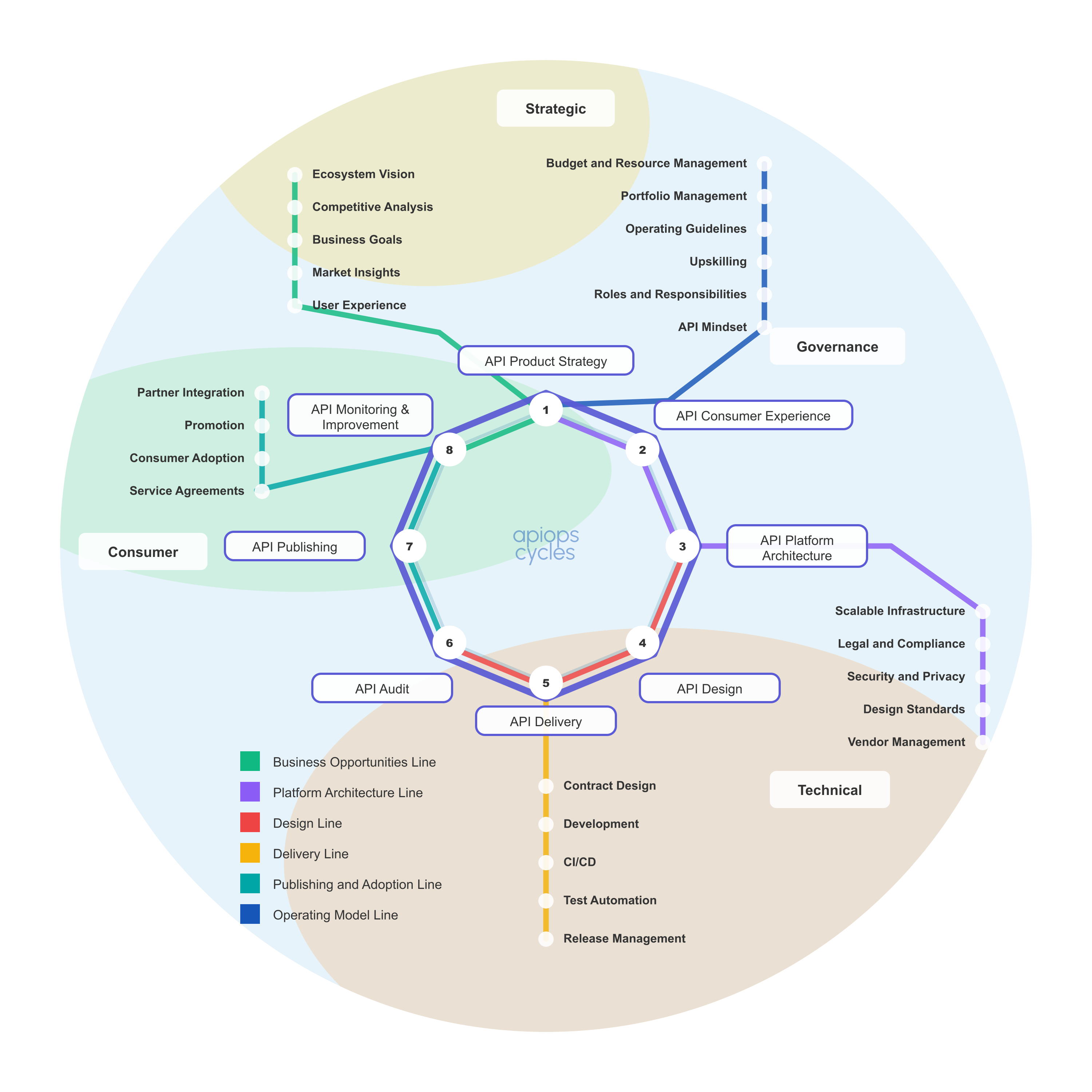
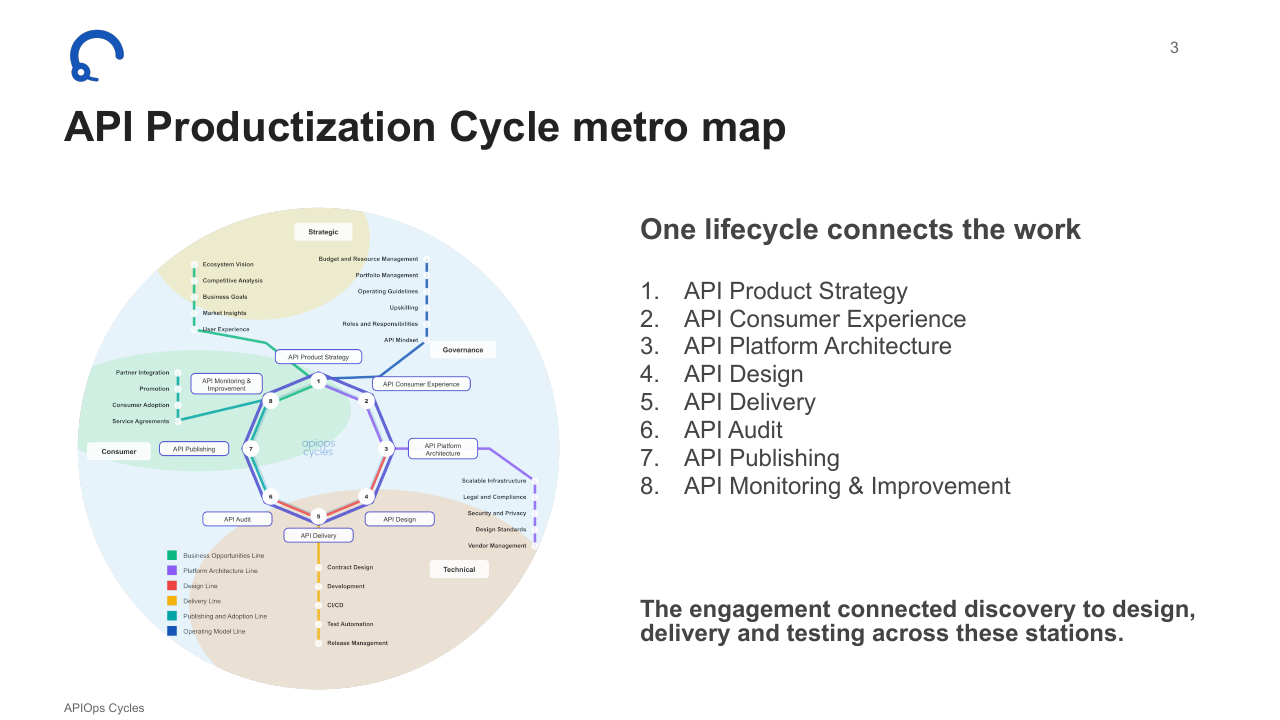
One lifecycle connects the work
- API Product Strategy
- API Consumer Experience
- API Platform Architecture
- API Design
- API Delivery
- API Audit
- API Publishing
- API Monitoring & Improvement
The engagement connected discovery to design, delivery and testing across these stations.
APIOps Cycles
04
Customer Journey Canvas: a supplier payment
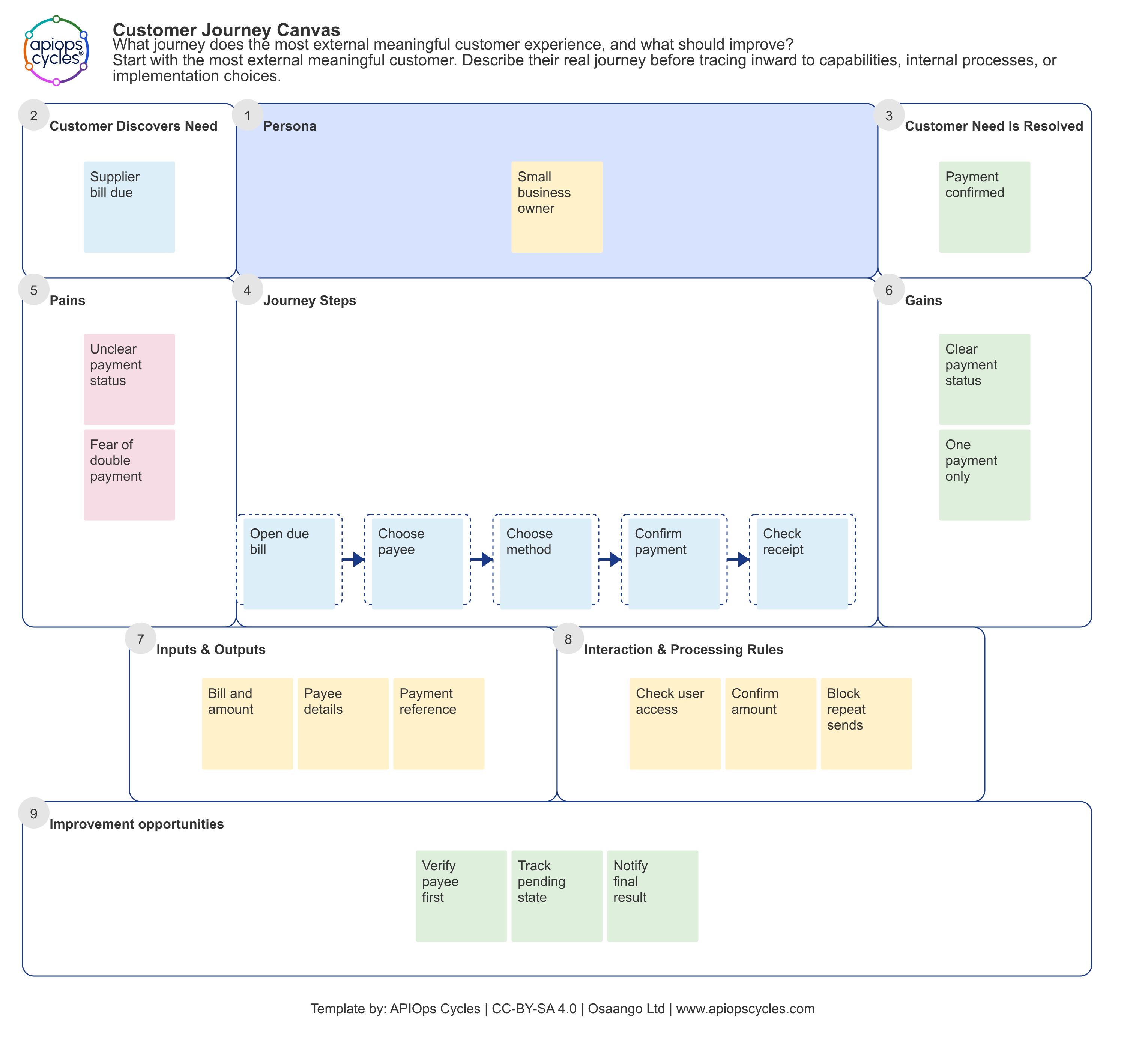
Customer and trigger
A small business owner has a supplier bill due and wants to know the payment has completed.
The customer journey
- Open the due bill
- Choose the payee
- Choose a payment method
- Confirm the payment
- Check the receipt
Illustrative example. Not a client artefact.
APIOps Cycles
05
API Value Proposition Canvas: the same journey
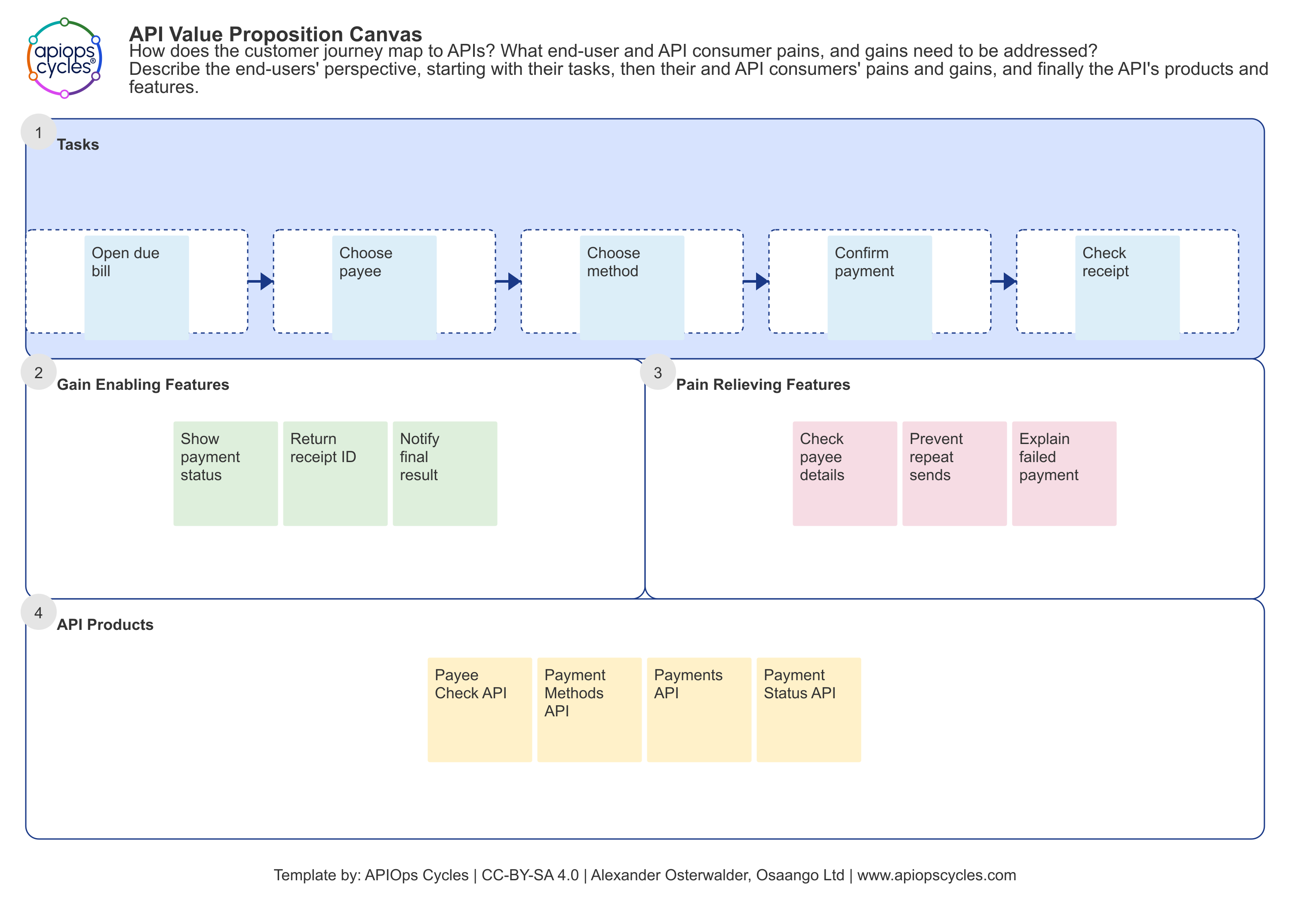
Customer concern to API feature
Unclear payment status:
show progress and a receipt.
Repeat-payment concern:
prevent duplicate submissions.
Candidate API products
- Payee Check API
- Payment Methods API
- Payments API
- Payment Status API
Illustrative example. API names are provisional.
APIOps Cycles
06
Architecture: business needs become operating decisions
| Method input | Decision it supports | Review with |
|---|
| Business Impact Canvas | Failure consequences, resilience
and acceptable degradation | Product owner, security
and operations |
| Locations Canvas | Trust boundaries, connectivity
and data-location constraints | Architecture, security
and compliance |
| Capacity Canvas | Demand, peaks, availability
and scaling assumptions | Business and platform
owners |
| Metrics and analytics | Observable service behaviour
and consumer outcomes | Operations and API
product owner |
The next station needs architecture choices that stakeholders have reviewed.
APIOps Cycles
07
Building with AI works best as a bounded change
- Select one reviewed operation and its acceptance criteria.
- Ask for an implementation diff and tests against the contract.
- Run checks, inspect behaviour and record unresolved decisions.
- Have the responsible people review the evidence before merging.
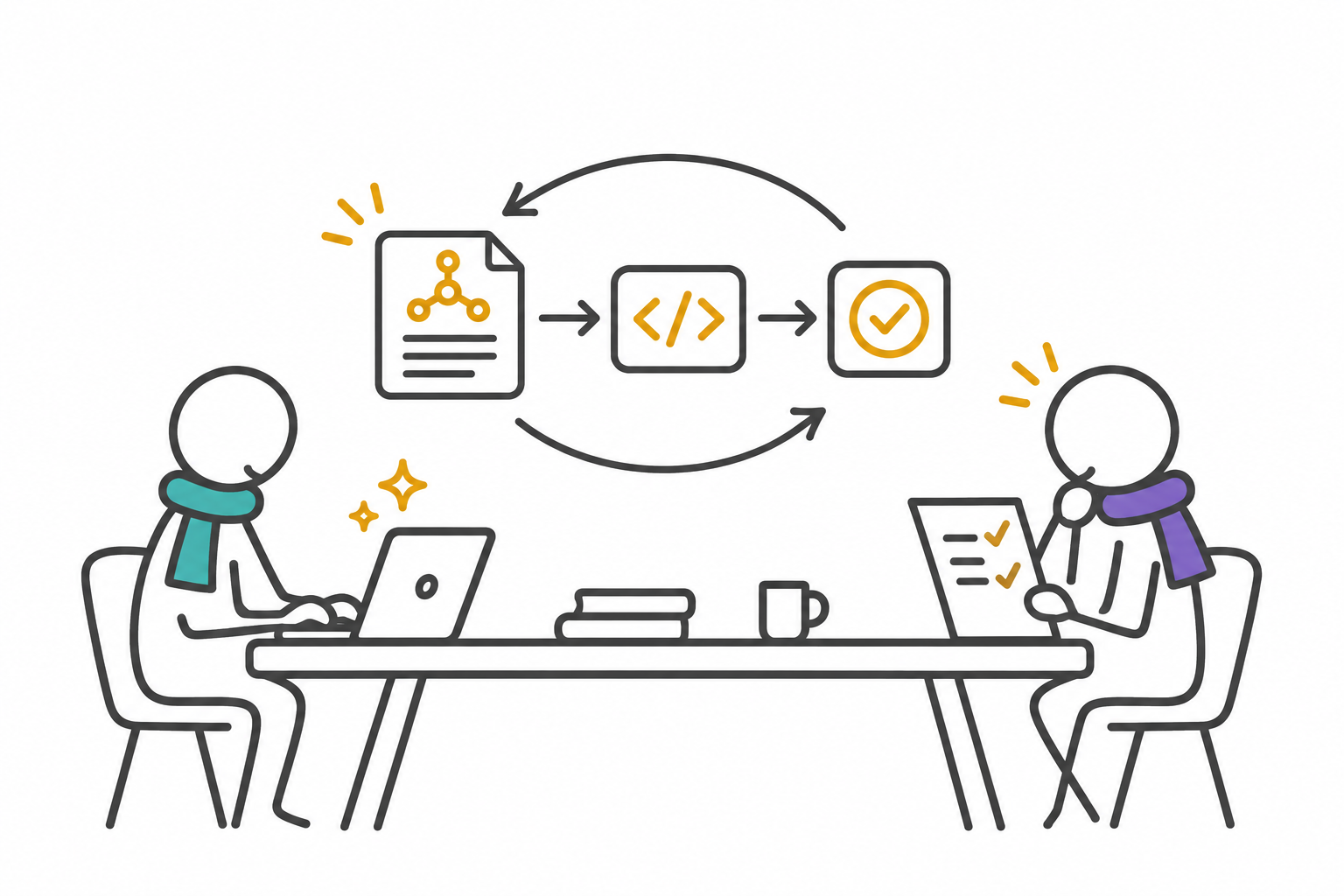
Suggested task: implement payment submission with replay and cross-partner denial tests.
APIOps Cycles
08
A first working cycle
- Agree one API product, a consumer journey and an accountable owner.
- Record the architecture choices and review one contract.
- Build one path with AI assistance and meaningful tests.
- Lint, audit and share findings before the next release decision.
Method and project resources
- apiopscycles.com
- apiops-cycles-method-data
- create-apiops
- CanvasCreator
Local reference versions checked: method-data 4.2.1 and create-apiops 1.1.4. 3 November 2026.
APIOps Cycles
Slide 1: APIOps Cycles
Read text version of slide 1
APIOps Cycles
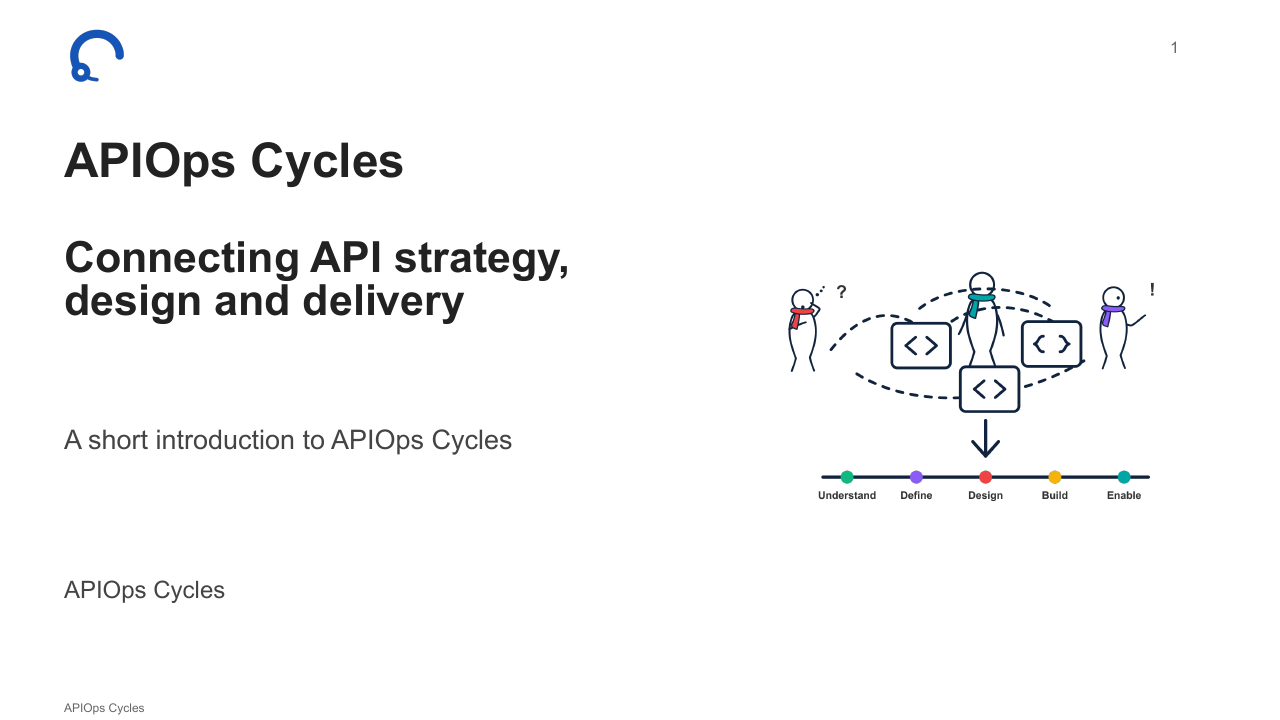
Connecting API strategy,
design and delivery
A short introduction to APIOps Cycles
APIOps Cycles
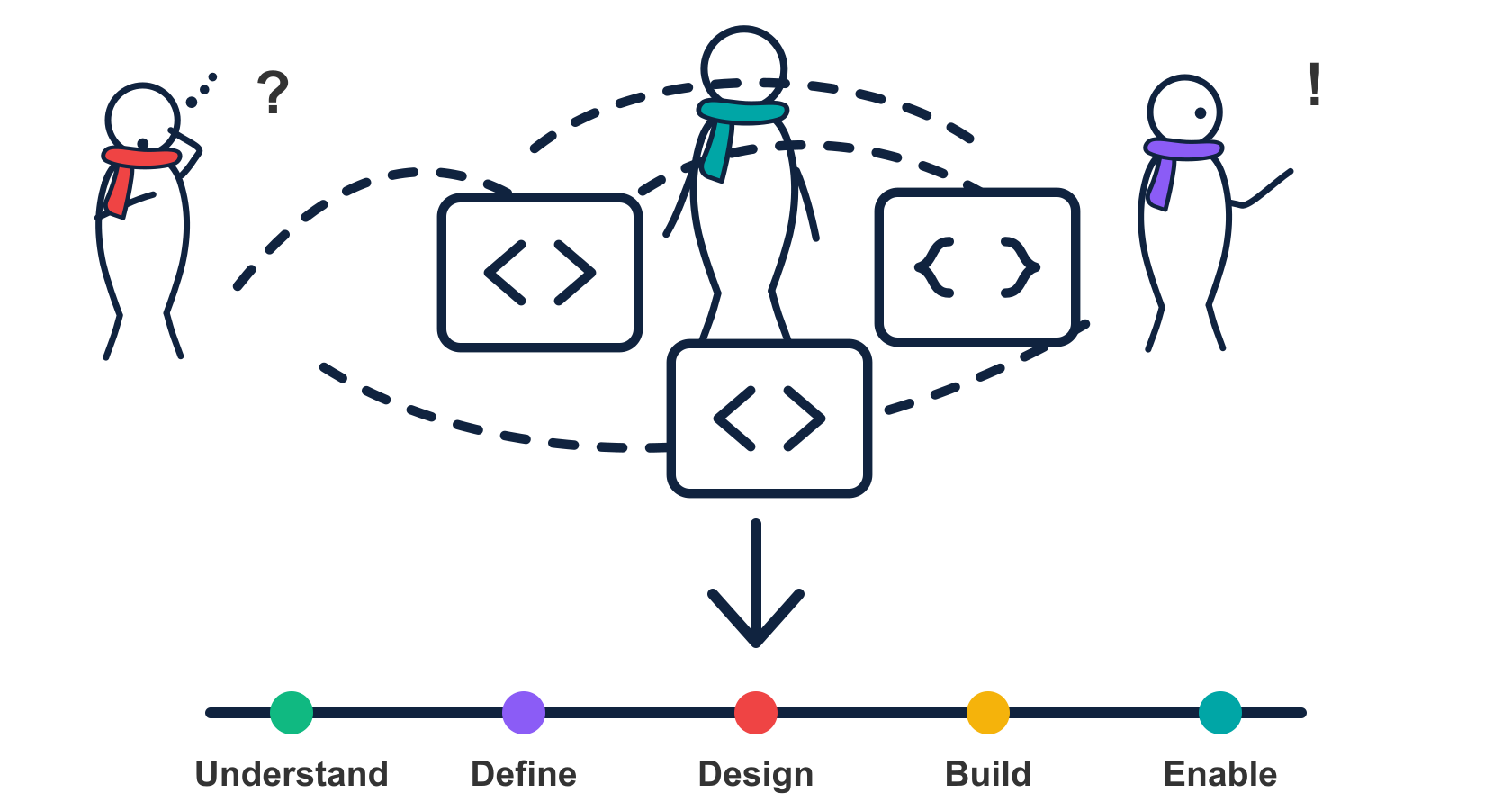
Visual: APIOps human scene showing connected discovery and delivery roles
Slide 2: APIOps Cycles connects decisions across the lifecycle
Read text version of slide 2
An open method for connecting consumer value with architecture, design, delivery and continuous improvement.
This introduction follows API Productization, with a financial-services case and an illustrative payment continuation.
Slide 3: API Productization Cycle metro map
Read text version of slide 3
Visual: Official API Productization Cycle metro map exported from the repository application
One lifecycle connects the work
- API Product Strategy
- API Consumer Experience
- API Platform Architecture
- API Design
- API Delivery
- API Audit
- API Publishing
- API Monitoring & Improvement
The engagement connected discovery to design, delivery and testing across these stations.
Slide 4: Customer Journey Canvas: a supplier payment
Read text version of slide 4
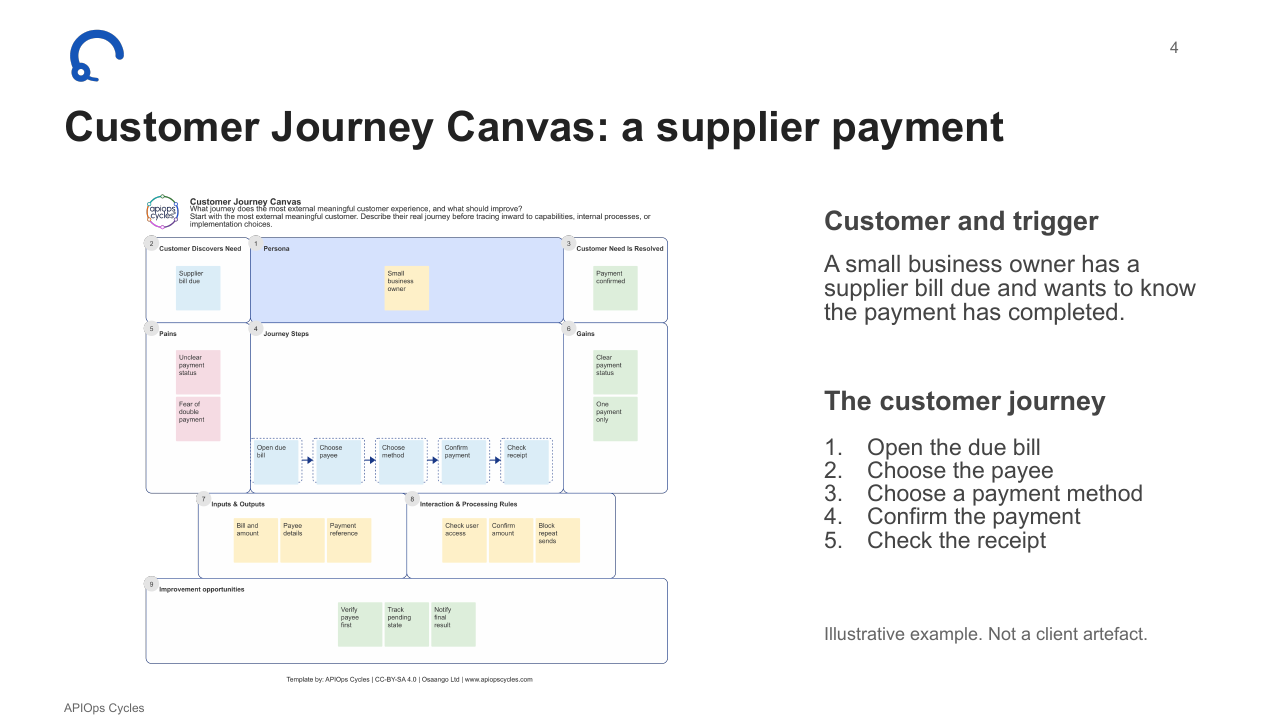
Visual: New illustrative filled Customer Journey Canvas for a small business owner paying a supplier invoice
Customer and trigger
A small business owner has a supplier bill due and wants to know the payment has completed.
The customer journey
- Open the due bill
- Choose the payee
- Choose a payment method
- Confirm the payment
- Check the receipt
Illustrative example. Not a client artefact.
Slide 5: API Value Proposition Canvas: the same journey
Read text version of slide 5
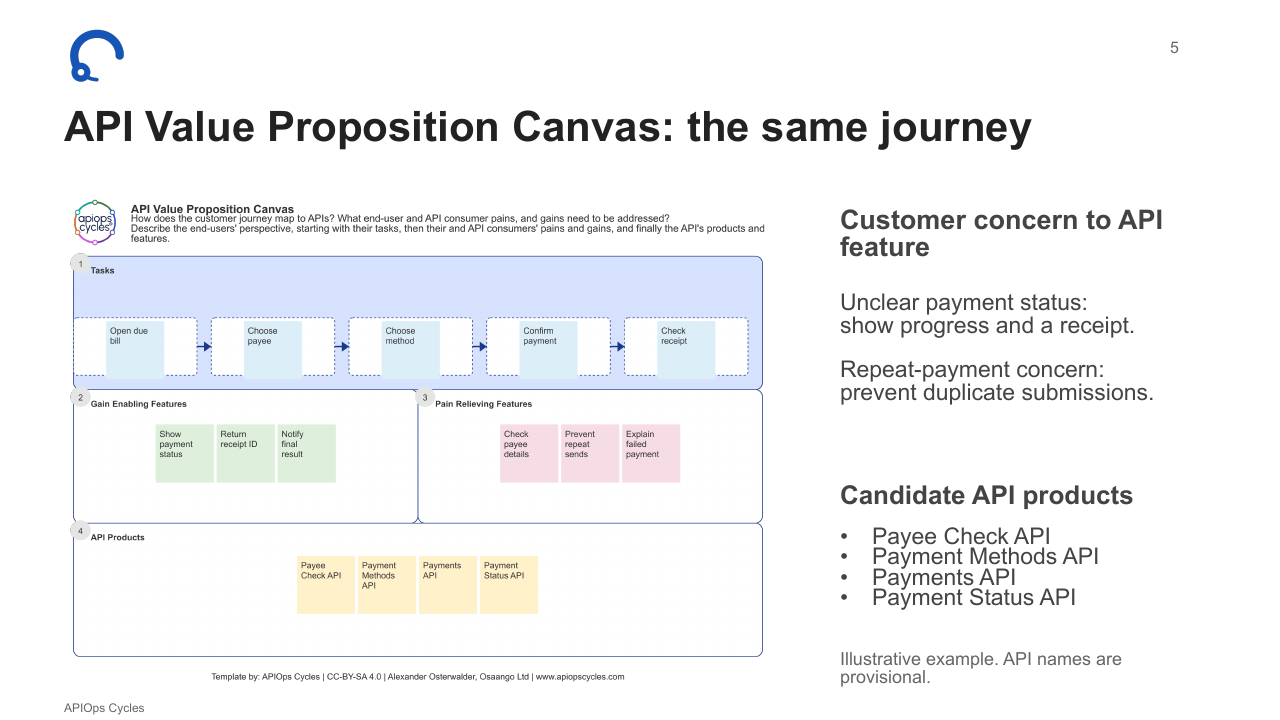
Visual: New illustrative filled API Value Proposition Canvas using the same supplier-payment tasks
Customer concern to API feature
Unclear payment status:
show progress and a receipt.
Repeat-payment concern:
prevent duplicate submissions.
Candidate API products
- Payee Check API
- Payment Methods API
- Payments API
- Payment Status API
Illustrative example. API names are provisional.
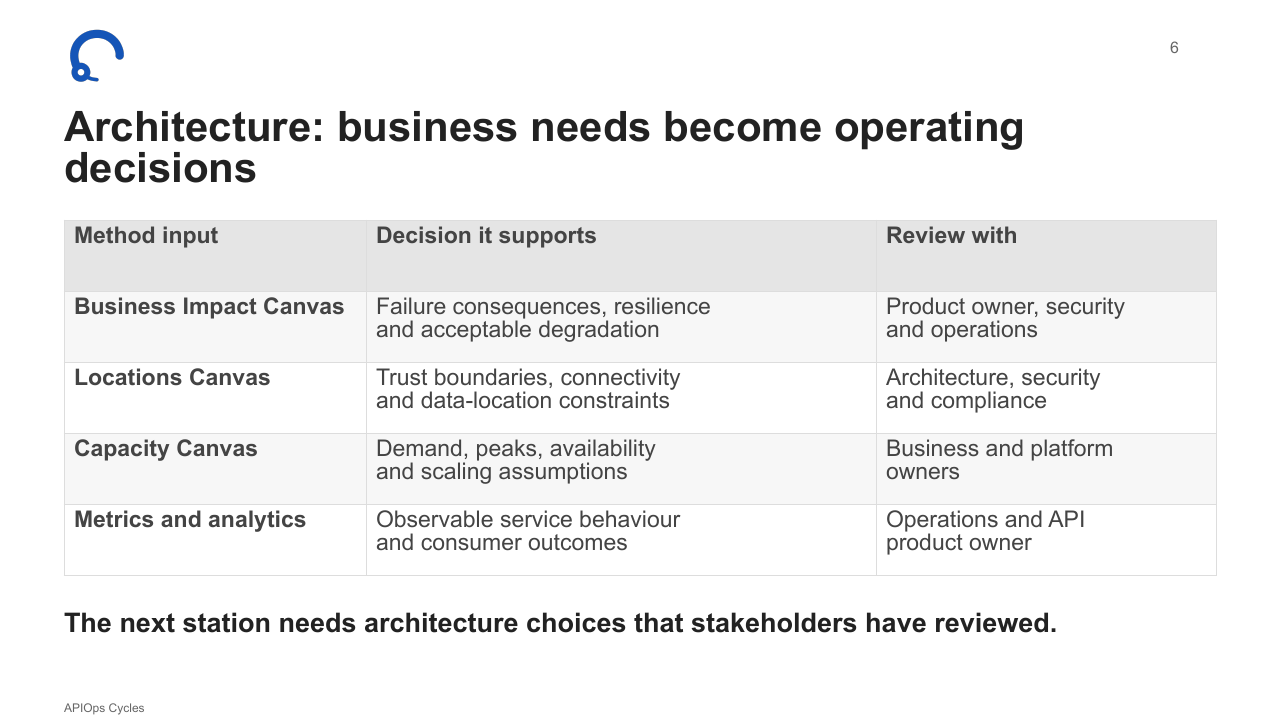
Slide 6: Architecture: business needs become operating decisions
Read text version of slide 6
The next station needs architecture choices that stakeholders have reviewed.
Slide 7: Building with AI works best as a bounded change
Read text version of slide 7
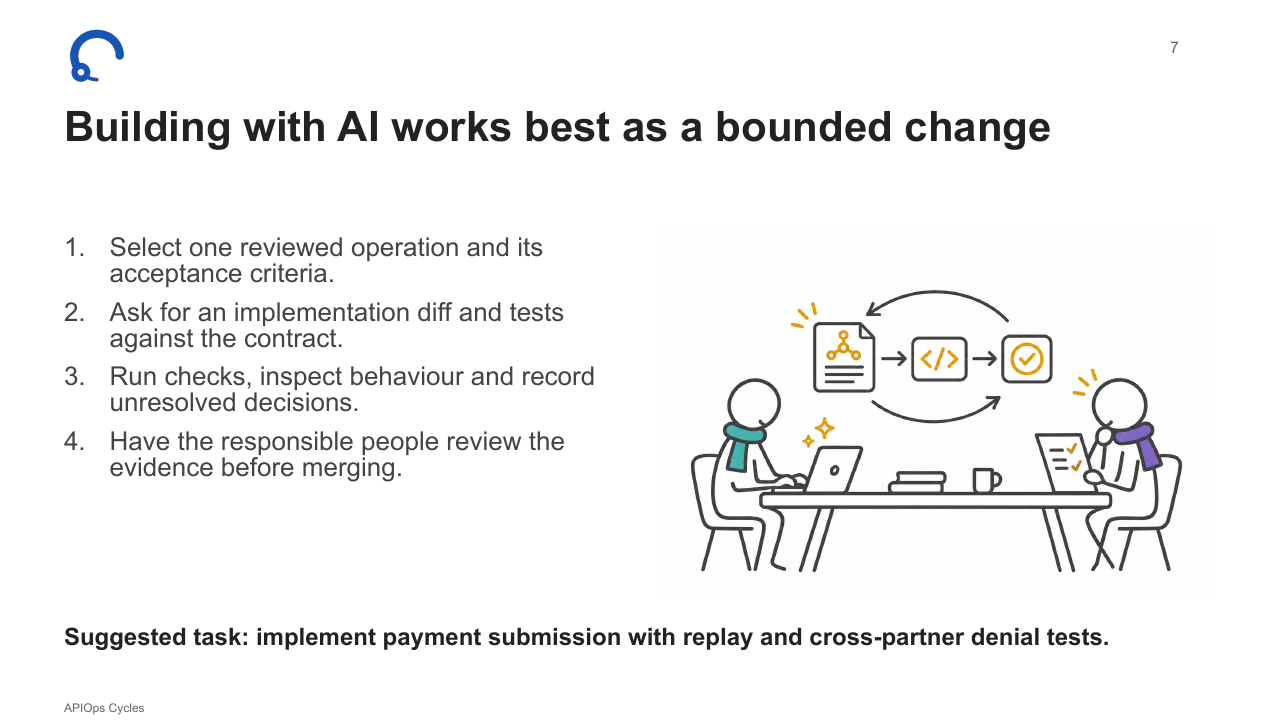
- Select one reviewed operation and its acceptance criteria.
- Ask for an implementation diff and tests against the contract.
- Run checks, inspect behaviour and record unresolved decisions.
- Have the responsible people review the evidence before merging.
Visual: Generated conceptual APIOps scene of AI-assisted implementation and human review
Suggested task: implement payment submission with replay and cross-partner denial tests.
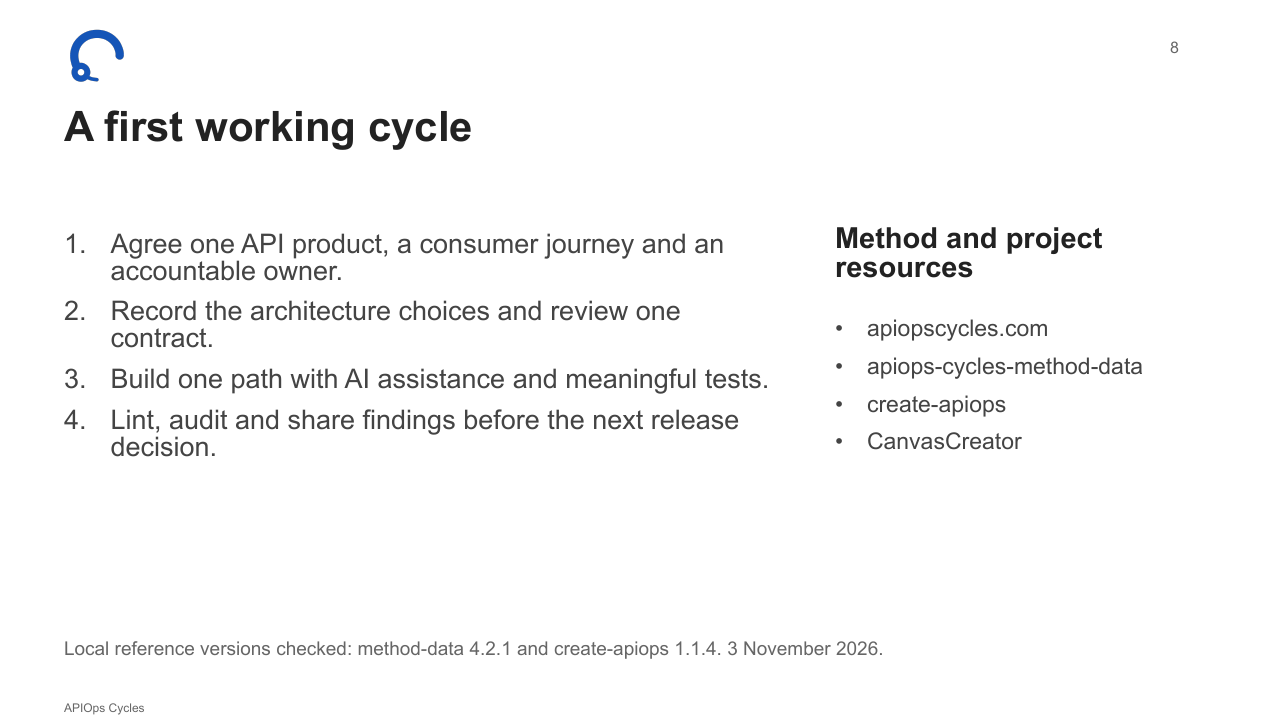
Slide 8: A first working cycle
Read text version of slide 8
- Agree one API product, a consumer journey and an accountable owner.
- Record the architecture choices and review one contract.
- Build one path with AI assistance and meaningful tests.
- Lint, audit and share findings before the next release decision.
Method and project resources
- apiopscycles.com
- apiops-cycles-method-data
- create-apiops
- CanvasCreator
Local reference versions checked: method-data 4.2.1 and create-apiops 1.1.4. 3 November 2026.
Use arrow keys or swipe to navigate, Esc for slide overview and S for speaker view. Back to presentation details and source.